Infertility testing starts with more than a semen sample: the doctor needs your reproductive history, examination findings, medications and, in selected cases, hormone, imaging, infection or genetic results. By the end, you will know how to prepare for testing, recognise the main semen measurements and understand which findings require repeat testing or further evaluation.
Key takeaways
- Avoid ejaculation for 2–7 days before providing a semen sample.
- Collect the entire sample in the laboratory’s sterile container.
- Repeat abnormal semen results before making treatment decisions.
- Assess both partners while investigating male infertility.
What happens during the first infertility consultation?
The first consultation identifies whether infertility may involve sperm production, sperm transport, sexual function, hormones or factors affecting both partners. Both partners should be assessed in parallel because age, ovulation, tubal factors and sperm findings jointly determine the chance of conception.
1. The doctor asks how long you have tried to conceive, how often intercourse occurs and whether either partner has conceived before. Report testicular injury, groin or pelvic surgery, mumps after puberty, infections, chemotherapy, undescended testes, erectile problems or ejaculation difficulties.
2. Bring previous semen reports, hormone results, scan reports and operation notes. Add a complete list of prescription medicines, supplements, testosterone, anabolic steroids and gym products; these can suppress sperm production.
3. The examination checks testicular size and consistency, the epididymides, vas deferens, pubertal features and any palpable varicocele. An imaging-only varicocele is not automatically a reason for surgery.
Seek evaluation after 12 months of regular unprotected intercourse, or sooner with azoospermia, prior chemotherapy, sexual dysfunction, testicular surgery or another known risk factor. This consultation is the practical starting point for infertility testing andrology treatment in Pune and an infertility consultation in Pune.
It directs the next steps rather than treating one semen result in isolation.
How should you prepare and submit a semen sample?
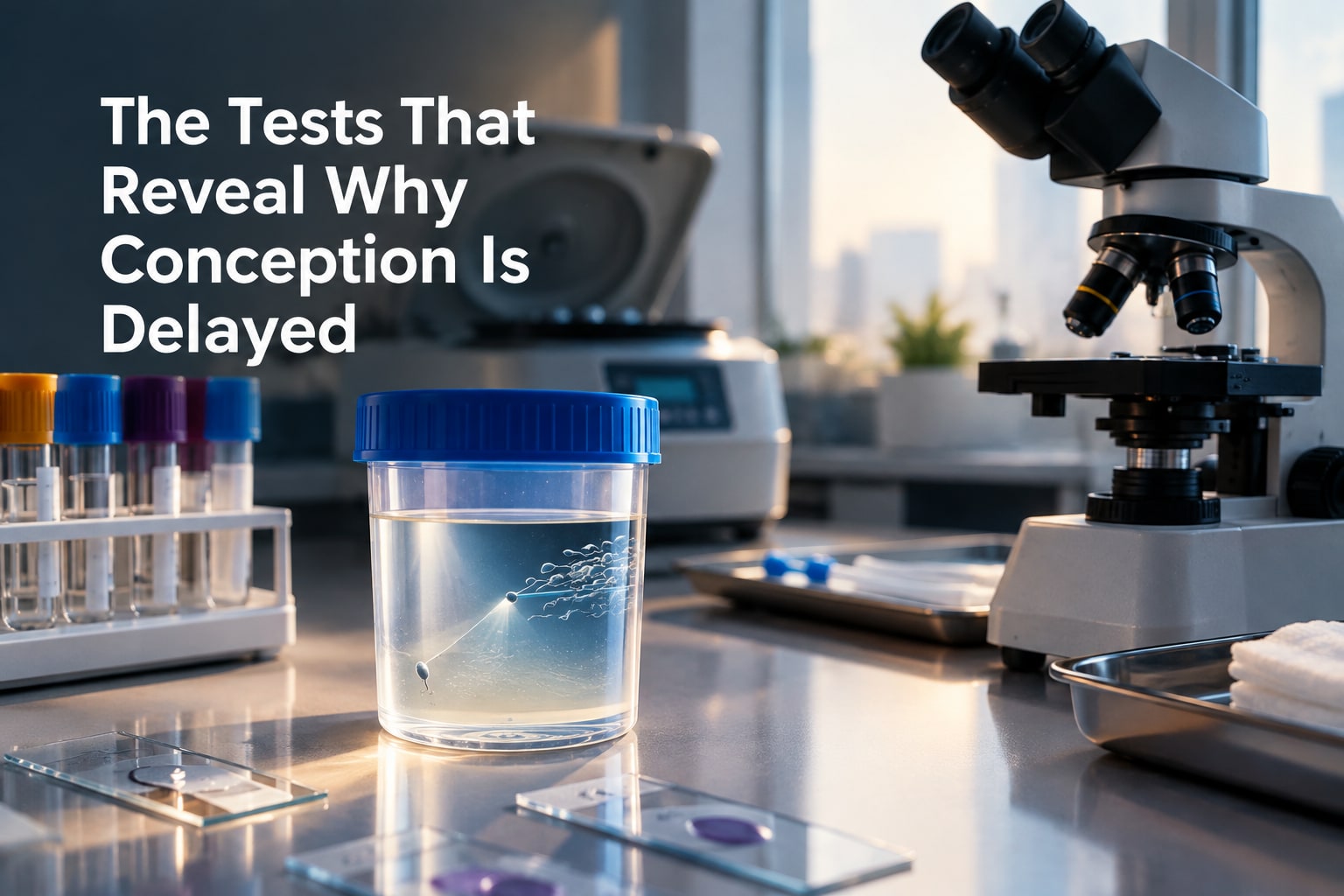
Prepare the sample exactly as the laboratory instructs; collection errors can look like a sperm-production problem. Most laboratories request 2–7 days without ejaculation, so record the exact abstinence period for the doctor interpreting the result.
- Ask whether you need an appointment, must collect on site, or may bring a sealed container from home.
- Wash and dry your hands, then collect the entire ejaculate by masturbation directly into the sterile container supplied or approved by the laboratory.
- Do not use a condom, household container or lubricant unless the laboratory provides a sperm-safe product. These materials can contaminate or damage sperm.
- Tell staff if any semen is spilled or missed, especially the first portion. Losing it can lower the reported volume and sperm concentration.
- Keep the closed container close to body temperature during transport. Do not refrigerate it, place it on ice or expose it to direct heat.
- Deliver it within the laboratory’s stated limit, commonly 30–60 minutes. Write down the collection time and arrival time.
Delay and temperature extremes can reduce measured motility, making the result appear worse than the sample’s usual quality. These details form a core part of male infertility testing in Pune and help separate a collection problem from a biological problem.
What do the numbers on a semen analysis mean?
A semen analysis is a group of measurements, not a single fertility score. Read each result alongside the others and the collection details.
| Measurement | What it records | How to interpret it |
|---|---|---|
| Volume | Amount of semen in the container | A low value can reflect incomplete collection or a problem with semen production or transport. |
| Sperm concentration | Sperm counted per millilitre | It shows density, not the number in the whole sample. |
| Total sperm number | All sperm in the ejaculate | It combines concentration with semen volume. |
| Motility | Percentage of sperm that move | Progressive motility identifies sperm moving forward, rather than only twitching. |
| Morphology | Percentage with typical shape | The laboratory applies strict criteria; a normal shape is not judged by appearance alone. |
| Vitality | Percentage of live sperm | This is especially useful when motility is very low. |
| Leukocytes | White blood cells or round cells | They can point toward inflammation and need clinical correlation. |
The 2021 WHO reference values place the lower fifth percentile at approximately 16 million sperm per millilitre, 39 million per ejaculate, 42% total motility and 4% normal morphology. These are reference limits, not a line between fertile and infertile. A man can conceive below them, while a result above them does not guarantee conception.
If the report is abnormal, repeat it, commonly after about one month. Sperm production and collection quality vary between samples, so one abnormal result does not prove permanent infertility. This interpretation guides male infertility testing in Pune and an andrology treatment for infertility plan.
When are hormone, urine, scan, infection and genetic tests added?
A normal semen report does not make every further test necessary. The history, examination and semen pattern decide whether a test answers a real clinical question.
Morning blood testing commonly includes total testosterone, follicle-stimulating hormone and luteinising hormone when sperm-production, small testes, low libido, erectile dysfunction or endocrine disease is suspected. Add prolactin for possible pituitary disease or hypogonadism. Order thyroid-stimulating hormone or estradiol when symptoms, examination findings or initial hormone results justify them.
Tell the doctor about:
- Testosterone injections or gels, anabolic or gym steroids, finasteride, dutasteride, cannabis, tobacco, alcohol and every other medicine or substance.
Testosterone and gym steroids can suppress sperm production or stop it, so disclosure must happen before an andrology treatment for infertility plan is made. Do not treat prescribed testosterone as a fertility treatment.
Urine testing, semen culture and other infection tests are used for urinary or genital symptoms, or white blood cells in semen; they are not automatic. Scrotal ultrasound clarifies a mass, epididymal problem or uncertain varicocele, but a palpable varicocele carries more clinical weight than an imaging-only finding.
Transrectal ultrasound is reserved for findings suggesting ejaculatory-duct obstruction.
Karyotyping and Y-chromosome microdeletion testing are considered with azoospermia or severe sperm-production failure. CFTR testing is relevant when the vas deferens is absent. A male infertility doctor in Pune can match each test to the clinical question instead of ordering everything at once.
How do test results change the treatment plan?
The next step depends on the cause—hormonal, obstructive, testicular, inflammatory, genetic or unexplained—and on whether both partners have completed assessment. A semen result alone cannot choose treatment.
1. Hormonal findings may lead to correcting testosterone injections, anabolic steroids or other androgen exposure before considering supplements. Men with documented hormone deficiency who want conception may need specialist-directed gonadotropins, not testosterone replacement, because testosterone can suppress sperm production.
2. A clinically palpable varicocele plus infertility and abnormal semen results may lead to a discussion about repair. An ultrasound-only varicocele that cannot be felt does not automatically justify surgery.
3. Obstruction may be treated with microsurgical reconstruction or sperm retrieval, depending on its location and whether the female partner’s assessment supports attempting natural conception or assisted reproduction.
4. Severe testicular sperm-production failure may lead to sperm retrieval with IVF or ICSI after genetic counselling. Karyotyping, Y-chromosome microdeletion testing or CFTR-related testing is targeted to the clinical pattern.
5. Inflammatory findings require correlation with symptoms and examination; unexplained results call for confirming abnormal semen findings and reviewing both partners’ timelines before expensive add-on treatment.
VANDANA URO CARE can help organise repeat semen testing and result interpretation within an andrology treatment for infertility plan in Pune. During an infertility consultation in Pune, ask what diagnosis each test addresses, when the result will be repeated and how it changes treatment.
Do not assume supplements, one semen report or a normal hormone value settles fertility prospects; this is the practical focus of infertility testing andrology treatment in Pune.
Frequently asked questions
What happens during the first infertility consultation?
The doctor reviews both partners’ medical and reproductive history, then assesses sperm production, sperm transport, sexual function, hormones and female fertility factors.
How should you prepare and submit a semen sample?
Avoid ejaculation for 2–7 days, wash your hands, collect the entire sample in the laboratory container and deliver it within the laboratory’s stated time limit.
What do the numbers on a semen analysis mean?
The report measures semen volume, sperm concentration, total count, motility, progressive motility, morphology, vitality and sometimes white blood cells.
When are hormone, urine, scan, infection and genetic tests added?
Doctors add these tests when semen results, examination findings, symptoms or the fertility history point to hormonal, urinary, structural, infectious or inherited causes.
How do test results change the treatment plan?
Results can lead to repeat testing, medicines, treatment for infection, varicocele or obstruction management, sperm retrieval, assisted reproduction or referral for female-factor care.