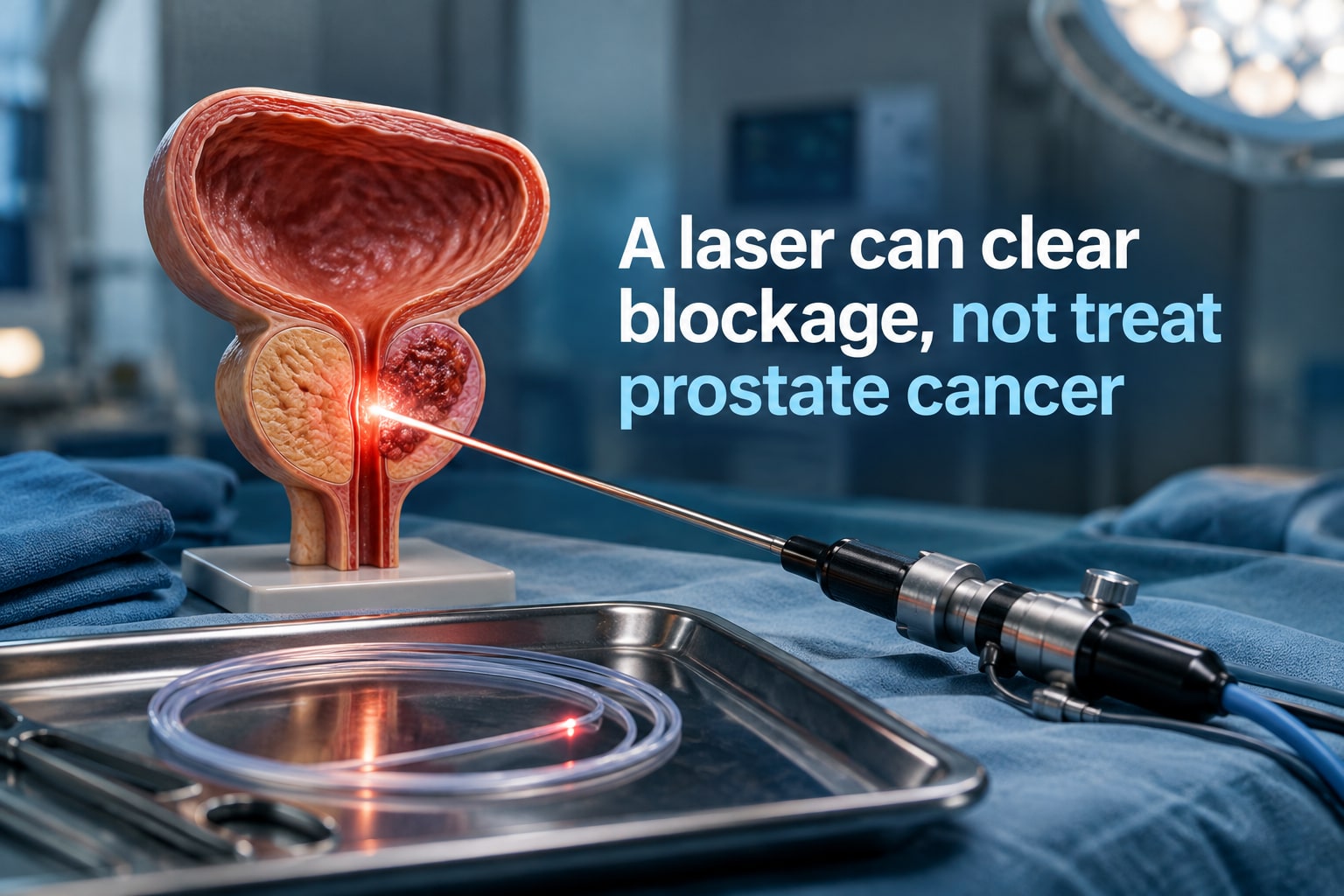
Laser procedures such as HoLEP and GreenLight surgery remove or vaporise tissue that blocks urine flow, but that purpose is different from eliminating prostate cancer. By the end, you will know which tests establish the diagnosis, which cancer treatments match each stage, and when a laser procedure has only a symptom-relief role.
Key takeaways
- Laser procedures treat urinary blockage from BPH, not cancer throughout the prostate.
- Confirm biopsy grade, PSA, MRI findings and cancer stage before choosing treatment.
- Ask whether active surveillance, prostatectomy, radiotherapy or systemic treatment fits your risk.
- Laser treatment can improve urine flow while leaving the cancer requiring separate care.
Why a prostate laser procedure is not usually cancer treatment
Most prostate laser surgery procedures—HoLEP, GreenLight photoselective vaporisation and thulium laser enucleation—treat benign prostatic enlargement (BPH). They remove or vaporise obstructing tissue inside the prostate; they do not reliably remove cancer throughout the gland, seminal vesicles, lymph nodes or distant metastatic sites.
Weak stream, urgency, frequency, nocturia and urinary retention do not identify the cause. BPH, prostate cancer, urinary infection and obstruction caused by previous treatment can produce the same symptoms. A large prostate or poor urine flow is not a reason to skip cancer assessment.
Routine laser surgery is the wrong first choice in these situations:
1. Cancer is suspected before biopsy. Obtain appropriate PSA assessment, a digital rectal examination and multiparametric MRI, followed by prostate biopsy when indicated or expert review of an existing biopsy.
2. A biopsy confirms cancer that needs curative treatment. The cancer’s Gleason Grade Group, TNM stage, volume, prostate size, age, life expectancy and overall health determine options such as radical prostatectomy or radiotherapy—not a standard BPH laser procedure.
3. Cancer is locally advanced, involves lymph nodes or has spread to bone or other organs. Removing obstructing prostate tissue cannot treat disease outside that tissue; treatment usually requires stage-appropriate systemic therapy.
A laser can later relieve retention from coexisting BPH, but improved urine flow is symptom control, not cancer control. Tissue removal can also affect PSA interpretation and delay definitive treatment.
How doctors determine prostate laser surgery suitability
The decision starts with cancer staging, not the word laser. To assess prostate laser surgery suitability, doctors collect a PSA blood test, perform a digital rectal examination and review a multiparametric MRI. They arrange a prostate biopsy when indicated, or obtain expert review of an existing biopsy.
The treatment decision must account for:
- Gleason Grade Group, TNM stage and estimated cancer volume
- Prostate size, urinary obstruction and bladder function
- Age, life expectancy and overall health
- Anticoagulant use and bleeding risk
- Previous prostate procedures
- The surgeon’s experience with the proposed technique
Laser procedures are not interchangeable. Their purposes and limitations differ:
| Procedure | Main purpose | Cancer-treatment concern |
|---|---|---|
| HoLEP | Removes obstructing tissue for BPH | Does not reliably eradicate cancer throughout the prostate, lymph nodes or metastatic sites |
| Photoselective vaporisation | Vaporises obstructing BPH tissue | Improves urine flow but does not provide whole-gland cancer control |
| Focal laser ablation | Destroys a selected tumour focus | Multifocal cancer can be missed, long-term control remains uncertain and intensive follow-up is required |
A large prostate or poor urinary flow is not a reason to bypass staging. Focal laser ablation should not replace whole-gland surgery or radiation outside a properly governed specialist programme or clinical trial.
If biopsy results show clinically significant cancer, doctors must match treatment to grade, stage and life expectancy rather than choose a procedure because it uses a laser.
Which cancer-directed treatment fits the stage and risk
The replacement for routine BPH laser surgery depends on the cancer’s risk group, spread and your fitness for treatment. The main choices are:
| Option | What it means | When it applies |
|---|---|---|
| Active surveillance | Scheduled PSA tests, examinations, repeat MRI and sometimes repeat biopsy; no immediate cancer treatment | Selected men with low-risk cancer confined to the prostate |
| Radical prostatectomy | Removes the prostate and seminal vesicles; pelvic lymph-node removal is added when nodal risk is significant | Fit patients with clinically localized cancer |
| External-beam radiotherapy or brachytherapy | Treats the prostate with radiation; intermediate- or high-risk disease may also need androgen-deprivation therapy | Localized cancer when radiation-based treatment is suitable |
| Systemic treatment | Androgen-deprivation therapy combined with other hormone medicines, chemotherapy or targeted agents | Locally advanced, lymph-node-positive or metastatic cancer |
Active surveillance is a planned cancer-monitoring programme, not a delayed laser operation. It requires reliable follow-up and a willingness to act if PSA, MRI or biopsy findings show progression.
Focal laser ablation is different from HoLEP or GreenLight surgery: it attempts to destroy a selected tumour focus rather than remove the whole prostate.
Missed multifocal cancer, uncertain long-term cancer control and intensive follow-up remain concerns, so it is not an established substitute for whole-gland surgery or radiation outside appropriately governed specialist programmes or clinical trials.
When a laser can relieve obstruction—and what problems remain
Laser enucleation is reasonable when coexisting BPH blocks the bladder outlet and causes retention or poor flow. It can be used during cancer treatment or in advanced disease to empty the bladder, but better flow is symptom control, not cancer control; it does not remove cancer from the rest of the gland or beyond it.
| Option | Immediate aim | What remains |
|---|---|---|
| Laser enucleation | Remove obstructing BPH tissue and improve flow | Cancer in untreated prostate, seminal vesicles, lymph nodes or distant sites remains |
| Cancer-directed treatment | Control prostate cancer according to stage and risk | Urinary obstruction may still need separate management |
The prostate surgery problems to weigh are:
- Bleeding or infection can require treatment, and temporary catheterisation can extend recovery.
- Urinary leakage or urgency can persist. Incomplete relief may require a repeat procedure.
- Urethral stricture or bladder-neck contracture can narrow the urinary passage later.
- The procedure can delay cancer-directed treatment, so agree on its timing with the cancer team.
- Retrograde ejaculation often greatly reduces or eliminates semen release. It is not loss of orgasm, but it requires fertility counselling.
- Erectile function can still change because of age, vascular disease, cancer or later treatment. Laser surgery does not remove erectile nerves in the same way as radical prostatectomy.
- Tissue removal alters PSA interpretation and cannot prove that cancer is absent elsewhere.
Questions to take to a prostate cancer decision in Pune
For cancers of prostate treatment in Pune, begin by confirming the diagnosis and stage, not by choosing the laser available. Take these questions to the appointment:
- Has an experienced genitourinary pathologist reviewed the biopsy?
- What are my Grade Group, PSA, MRI findings, TNM stage and estimated cancer volume? Please provide them in writing.
- Does the proposed laser treat cancer, or only relieve urinary obstruction?
- If I choose a laser, how will it affect later PSA interpretation, biopsy planning and the timing of definitive treatment?
Compare the alternatives against your cancer risk and life expectancy:
| Option | Expected benefit | Main trade-offs |
|---|---|---|
| Active surveillance | Avoids immediate treatment for selected low-risk, confined cancer | Requires scheduled PSA tests, examinations, repeat MRI and sometimes repeat biopsy |
| Radical prostatectomy | Removes the prostate and seminal vesicles; lymph nodes may also be removed | Urinary leakage and erectile dysfunction are possible |
| Radiotherapy or brachytherapy | Treats the prostate without removing it | Urinary, bowel and sexual effects; androgen-deprivation therapy may be added |
| Systemic treatment | Controls locally advanced, lymph-node-positive or metastatic disease | Hormone medicines, chemotherapy or targeted agents have whole-body effects |
A prostate cancer consultation in Pune is most useful when urology, radiation oncology and medical oncology input is available for intermediate-risk, high-risk, locally advanced or unclear cases. VANDANA URO CARE can be considered for a discussion that matches diagnosis, anatomy and life expectancy to treatment, rather than selecting a procedure because it uses a laser.
Related service
Prostate Laser Surgery Prostate laser surgery is used to relieve moderate to severe urinary symptoms caused by an enlarged prostate — a condition known as benign prostatic... View service → |
Frequently asked questions
Why is prostate laser surgery not usually a treatment for prostate cancer?
HoLEP, GreenLight and thulium laser procedures remove or vaporise tissue blocking urine flow from benign enlargement. They do not reliably remove cancer in the whole prostate, seminal vesicles, lymph nodes or distant sites.
How do doctors determine prostate laser surgery suitability?
They assess your symptoms, urine blockage, prostate size, PSA, digital rectal examination, MRI, biopsy findings, cancer stage and overall health. Laser surgery suits obstruction from benign enlargement when it will improve urinary function.
Which treatments can fit prostate cancer stage and risk?
Options include active surveillance, radical prostatectomy, radiotherapy, androgen-deprivation therapy and other systemic treatments. The choice depends on grade group, PSA, tumour extent, spread, age, health and personal priorities.
Can a laser relieve urinary obstruction caused by prostate cancer?
A laser can sometimes improve obstruction and urine flow, but it does not remove all cancer or prevent cancer progression. You still need a separate cancer treatment plan and follow-up.
What should you ask during a prostate cancer consultation in Pune?
Ask for your biopsy grade group, PSA interpretation, MRI stage, evidence of spread, treatment alternatives, expected urinary and sexual effects, recovery time and the plan if symptoms continue after laser surgery.