Sweating, dehydration and reduced urine volume during Pune’s hot weather can encourage stone formation, but blood in the urine must not be blamed on a stone without assessment. You will learn how to respond safely, which tests distinguish a stone from infection or other disease, and how treatment is selected.
Key takeaways
- Seek emergency care for fever, severe pain, vomiting, or difficulty passing urine.
- Urine tests, kidney-function blood tests, and imaging identify stones and obstruction.
- Stone size, location, and blockage determine whether you need observation or a procedure.
- Increase fluids and complete stone analysis to reduce recurrence risk.
Why Pune’s hot weather raises kidney stone risk
Pune’s hot weather raises kidney stone risk because sweating removes water while stone-forming salts remain in the urine. If you replace too little fluid, urine volume falls and becomes more concentrated, allowing crystals to join into stones and irritate the urinary tract.
For summer kidney stone care in Pune, manage fluids by:
- Drinking enough to produce at least 2.5 litres of urine over 24 hours, rather than counting a fixed number of glasses.
- Spreading water intake across the day and drinking more before, during and after outdoor activity or heavy sweating.
- Checking that urine is usually pale yellow; persistently dark urine suggests that you need more fluid unless a clinician has restricted your intake.
Do not force extra fluids if you have heart failure, advanced kidney disease or a prescribed fluid limit. Ask your doctor for an individual daily target. Vomiting, inability to keep fluids down, dizziness or sharply reduced urine output needs medical care because dehydration can worsen obstruction and kidney injury.
Repeated self-medication with anti-inflammatory painkillers while dehydrated can also harm the kidneys.
What blood in the urine can mean, and when it is an emergency
Blood in urine can appear when a stone scrapes the lining of the kidney, ureter or bladder. It may look pink, red or cola-brown, or appear only on a urine test.
Do not assume visible bleeding is caused by kidney stones in Pune; infection, kidney disease, prostate disease, blood-thinning medicines and urinary-tract cancer also require consideration.
| Cause | Clues | Why it matters |
|---|---|---|
| Kidney stone | Waves of flank or groin pain, nausea | A moving stone can bleed or block urine flow |
| Urinary infection | Burning urine, urgency, fever or chills | Infection behind an obstruction can become dangerous quickly |
| Kidney disease | Protein or blood on testing, swelling, high blood pressure | The kidney filter may be affected |
| Prostate disease | Weak stream, difficulty starting, frequent night-time urination | Prostate enlargement or inflammation can bleed |
| Cancer or medication effect | Persistent painless bleeding, smoking history, anticoagulant use | Persistent or unexplained bleeding needs urological assessment |
Seek same-day emergency care if blood in urine comes with:
- Fever, chills, confusion or marked weakness
- Severe or worsening side pain, repeated vomiting, or inability to drink
- Inability to pass urine, very little urine, or blood clots blocking the stream
- Fainting, dizziness, heavy bleeding, or a single functioning kidney
Even after pain settles, persistent visible blood needs evaluation rather than reassurance.
The first assessment: urine tests, blood tests and imaging
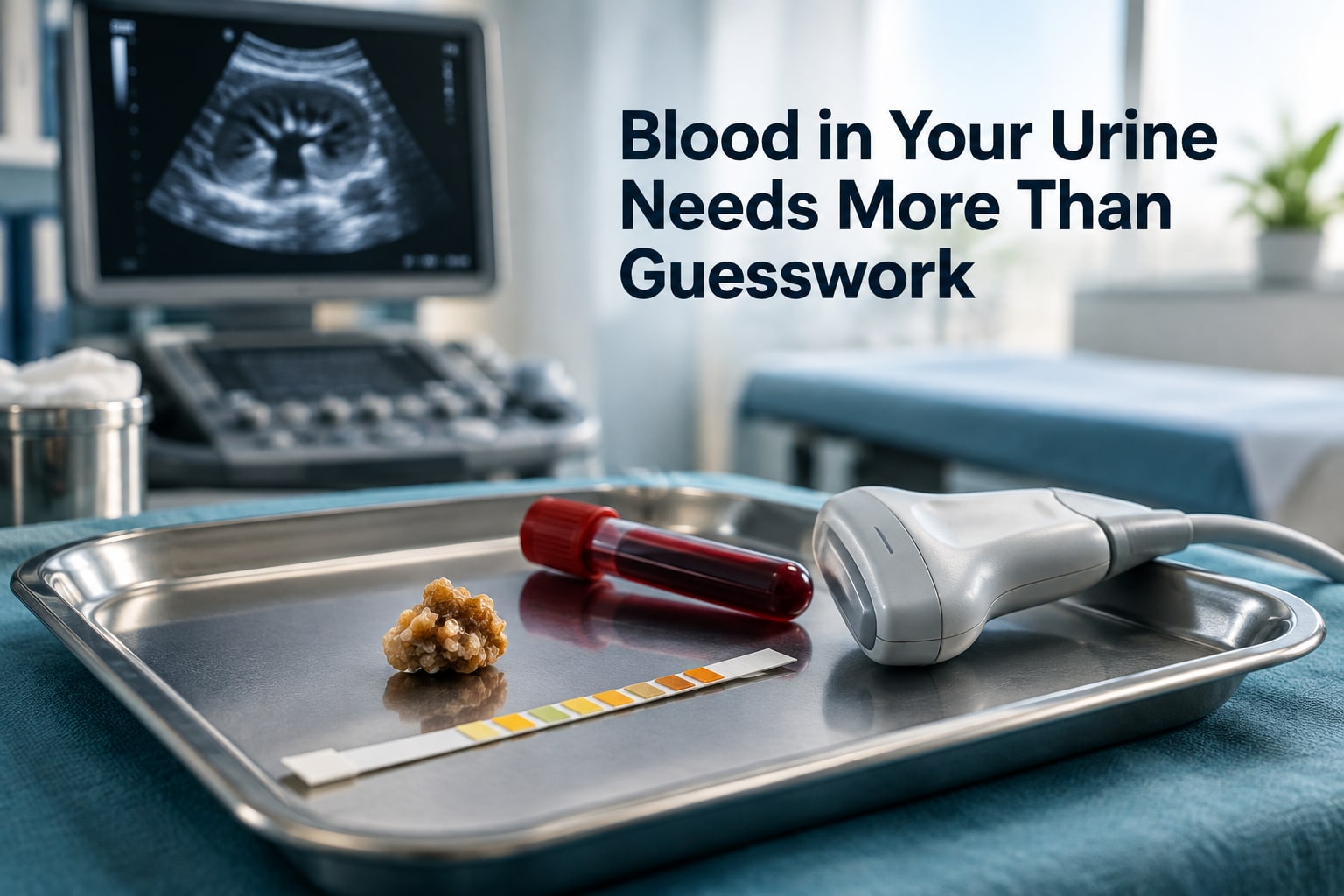
Urinalysis, kidney-function blood tests and imaging answer three separate questions: Is a stone present? Is urine flow blocked? Is infection or kidney injury developing? The combination matters because an infected, obstructed kidney needs urgent drainage, not pain relief alone.
| Check | What it finds | Why it matters |
|---|---|---|
| Urinalysis and urine culture | Red cells, white cells, crystals, protein and bacteria | Confirms blood, identifies infection and guides antibiotics |
| Creatinine, eGFR, electrolytes and complete blood count | Reduced filtration, inflammation and anaemia | Shows kidney stress and supports assessment of infection |
| Ultrasound or non-contrast CT of the kidneys, ureters and bladder | Stone location and size; swelling above a blockage | CT detects small or ureteric stones more reliably; ultrasound avoids radiation |
For kidney stones in Pune, ultrasound is often a practical first scan, but a non-contrast CT KUB gives clearer answers when pain persists, the diagnosis is uncertain or obstruction is suspected. A raised creatinine, fever, chills, vomiting or reduced urine needs prompt review.
If blood in urine continues after no stone is found, ask for urological evaluation; cystoscopy and upper-tract imaging may be needed to assess the bladder, ureters and kidneys for other causes.
How stone size, location and obstruction determine treatment
Observation is reasonable for a small stone when urine drains, there is no infection, kidney function is stable, and pain remains controlled. Repeat imaging confirms that it is moving or has cleared. Tamsulosin, an alpha-blocker, can help selected adults pass a distal ureteric stone, with greatest benefit reported for stones above 5 mm.
It does not dissolve most stones and needs a prescription after obstruction and contraindications are assessed.
The right kidney stone treatment in Pune depends on size, location, density, anatomy, body habitus and your preference—not just bleeding or pain.
| Option | Best fit | Main trade-off |
|---|---|---|
| Shock-wave lithotripsy | Smaller kidney or upper-ureter stones that can be targeted from outside | No incision, but dense stones, lower-pole stones or larger stones may need repeat sessions; fragments can obstruct |
| Ureteroscopy with laser | Ureter stones and kidney stones needing direct removal | High immediate clearance, but requires anaesthesia and often a temporary ureteric stent |
| PCNL | Kidney stones larger than about 2 cm, staghorn stones or heavy stone burden | Usually the strongest single procedure for large stones, but requires a small back incision and carries bleeding and hospital-recovery risks |
Fever, chills, sepsis, an infected blocked kidney, worsening kidney function, uncontrolled pain or a solitary kidney changes the decision. Drain the system immediately with a ureteric stent or nephrostomy and give antibiotics; delay stone removal until infection clears. Persistent obstruction without infection also warrants prompt urological review.
Preventing another stone after the bleeding settles
Aim to produce at least 2.5 litres of urine daily, not merely drink a fixed number of glasses. Spread water across the day and add fluids during outdoor activity in Pune’s hot season; sweating raises your requirement. If heart or kidney disease limits fluids, follow your clinician’s prescribed target.
Vomiting, inability to drink or reduced urine output needs medical care.
For summer kidney stone care in Pune, use these diet and testing steps:
- Keep normal dietary calcium unless a clinician advises otherwise; cutting it sharply can increase oxalate absorption.
- Reduce salt, packaged foods and large portions of animal protein.
- Retrieve any passed or removed stone for laboratory analysis. Calcium, uric-acid, infection-related and cystine stones require different prevention plans.
- Ask about 24-hour urine testing and blood tests if stones recur, are multiple or bilateral, began in childhood, or have unusual features.
Passing a stone or completing a procedure does not prove the urinary tract is clear. Arrange clinician-directed ultrasound or CT follow-up to check for residual fragments and silent obstruction. Persistent blood in urine requires further evaluation, including cystoscopy or upper-tract assessment when indicated.
Choosing coordinated kidney stone and blood-in-urine care near Pune
If you searched kidney stones blood in urine treatment in Pune, choose a service that can handle both problems. A kidney stone specialist near Pune should coordinate urine microscopy and culture, creatinine and eGFR, imaging for obstruction, and—when bleeding persists or no stone is confirmed—cystoscopy or upper-tract evaluation.
Infection, prostate disease, blood-thinning medicines, kidney disease and urinary-tract cancer can all mimic stone-related bleeding.
For kidney stone treatment in Pune, ask:
- Can you treat an obstructing or infected stone urgently?
- Who investigates persistent hematuria if the stone passes?
- Will you retrieve and analyse a stone for composition?
- What follow-up imaging checks for residual fragments or silent obstruction?
| Care capability | Verify before booking | Best fit |
|---|---|---|
| Stone-focused urology | Treatment options and stone analysis | Recurrent or complex stones |
| Coordinated urology | Hematuria work-up plus acute stone care | A stone with persistent bleeding |
| Uro-oncology capability | Cystoscopy and upper-tract assessment | Unexplained visible blood or cancer risk |
VANDANA URO CARE’s urology and uro-oncology scope makes it a service to assess against these criteria, rather than assuming every episode of blood came from a stone.
Related service
Kidney Stone Treatment What is the best treatment for kidney stones? Image result for Kidney Stone Treatment Percutaneous Lithotripsy (PCNL) is the best treatment for large... View service → |
Frequently asked questions
Why does hot weather increase kidney stone risk in Pune?
Sweating reduces body water, leaving less urine to dilute stone-forming salts. Drinking too little fluid makes crystals more likely to join into stones.
When is blood in the urine an emergency?
Seek urgent medical care for blood in urine with fever, chills, severe or persistent pain, repeated vomiting, inability to pass urine, or weakness. These symptoms can indicate infection, obstruction, or significant bleeding.
Which tests assess blood in urine and suspected kidney stones?
Assessment can include a urine routine and microscopy, urine culture when infection is suspected, blood tests for kidney function and infection, and imaging such as ultrasound or a non-contrast CT scan.
How do stone size, location, and obstruction affect treatment?
Small stones that are not causing dangerous blockage may pass with monitoring and prescribed symptom relief. Larger stones, stones stuck in the ureter, persistent pain, infection, or impaired drainage may require a procedure.